Along with the armor, I felt that the crossbow could use a visual update. The previous crossbow wasn't bad, but it wasn't great either. I went for a futuristic look but also something eye catching. At the time that I was texturing I was thinking of an old project I did my first semester. It was a shooting game involving a lot of spiders. I based the textures off of that texture.
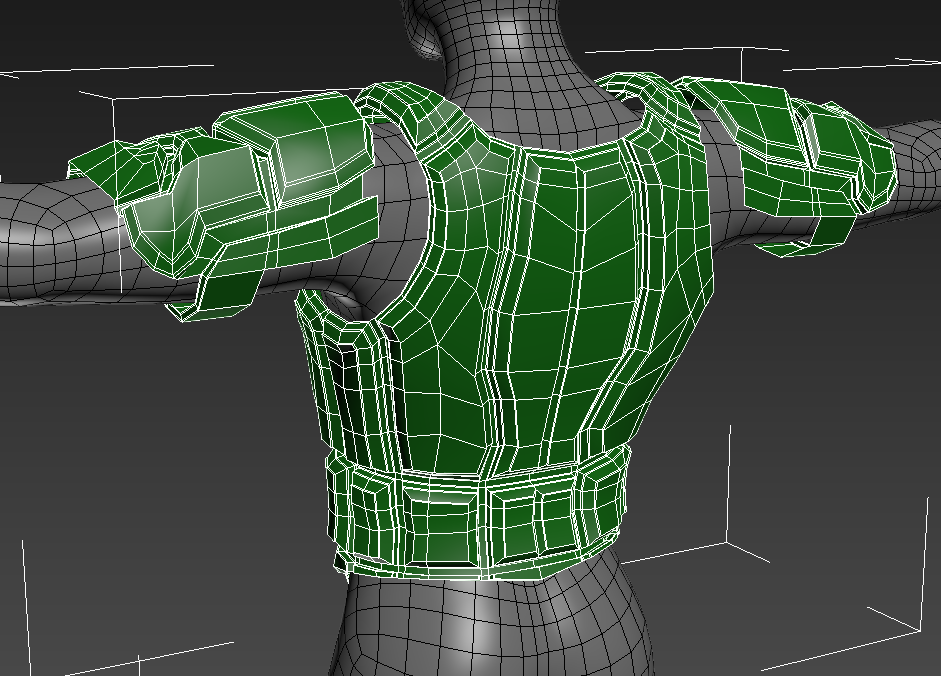
I finished the armor modeling. However, I had a lot of geometry that I felt that I could remove. In the hard surface modeling tutorial I watched, support edge loops were used a majority of the time. These loops helped with telling 3ds Max that the edge between the other two was a hard edge. Although these loops helped initially, this model is for a game, and geometry is limited, so I looked up trying to use smoothing groups on the model to achieve the same look but with less geometry.
Video on using smoothing groups for exporting in Mudbox.
I managed to use smoothing groups effectively. I was able to export my file into Mudbox while keeping the hard surface look that normally would have been smoothed out. I was able to optimize my model. Below is a comparison. Utilizing smoothing groups, I was able to cut my poly count by roughly 2500 while having little to no change in appearance.
After watching the video, I got a good idea and concept of hard surface modeling. I modeled out a couple of pieces.
After receiving some critiques on my concepts, I can start working on modeling out the armor for the William tell armor. I decided to try to take elements of the concepts and model out armor pieces. I'm trying to maintain the style but give it a futuristic look to it. It's a little challenging because I never really liked modeling out hard surfaces since I've had difficulties with it in the past; I prefer organic modeling. I looked at some tutorials to see if I can get a better understanding of hard surface modeling.
After doing research. I created several concepts for the William Tell character. I used the real-life references as my influence. I focused more on the type of armor and design of the armor than the color. Also, I realized that we want a futuristic look, but that can be accomplished through the model/texturing.
The art team is doing a bit of back peddling. We're starting with coming up with concepts for the crossbowman/rocket man. We had some concept art from the previous semester, but a lot of them weren't used. Also, there wasn't much direction when we created the original concepts. By redoing this step, hopefully we'll have a more streamline art style. I'm focusing on the William Tell character, and primarily researching armor from that era. Then once I have some good references, I can start making concepts. Here are several examples I found.
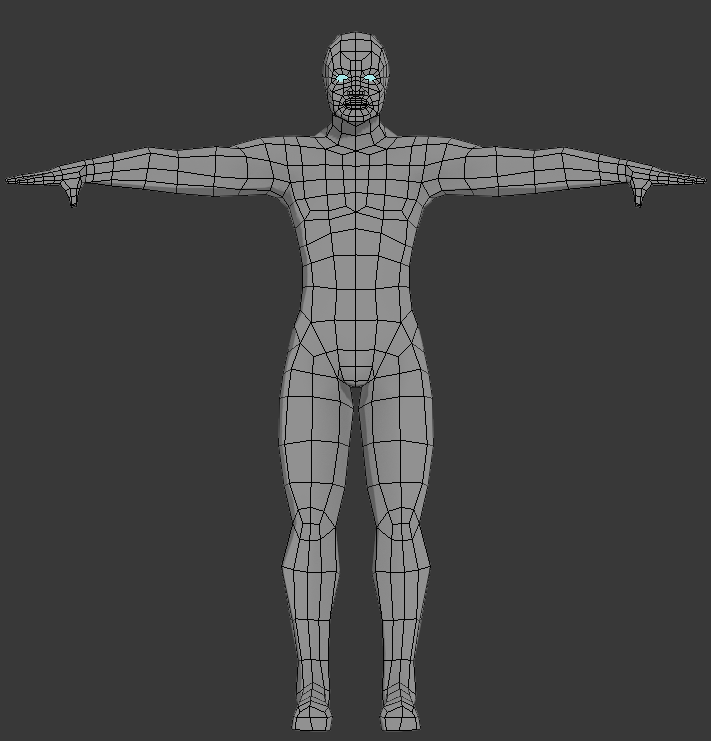
Over winter break, I had practiced my modeling a little. I created a low poly male base mesh. Previously, we had only created armor pieces and skinned them to a biped system. The main issue with that was that if any part of armor wasn't covering something, the result would be an invisible body. The crossbowman was a prime example since the helm was merely a hat. Since we didn't have a mesh underneath, the entire head/neck area was invisible. The new mesh will fix any issue of that invisibility.
The semester has started and we're going right into it. Last semester was a bit hectic. I think we'll be planning on redoing a lot of the art assets/models. The ones from last semester were ok; not horrible, but great either. This first week I'm going to have the art team rework our pipeline. D'Merro came up with a concept pipeline over the break so we'll be testing it out. Primarily, we're just going to make sure we can get from a 2d concept to a 3d model/animations; we want to get these into the game engine smoothly.